
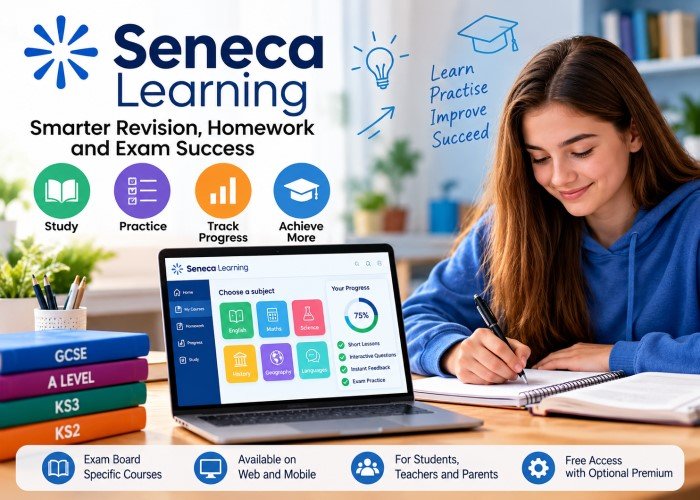
Seneca Learning helps pupils study school subjects through short lessons, questions and instant feedback. It is used in UK schools and at home. The platform brings learning materials, homework and revision into one place, making it easier to practise a little each day. Much of its teaching content is free. Teachers can also set tasks without paying for a basic account. Yet it cannot replace teaching or exam practice. Knowing what the platform does well helps pupils use it with purpose.
Seneca Learning at a Glance
| Feature | Details |
|---|---|
| Type | Online study, homework and revision platform |
| Main users | Pupils, teachers and parents |
| Study levels | KS2, KS3, GCSE, A Level and selected IB courses |
| Subjects | English, maths, science, history, geography, languages and more |
| Free access | Hundreds of courses and standard homework tools |
| Paid access | Extra courses, study modes and exam practice |
| Devices | Web browsers, Android phones and iPhones |
| Main strength | Short lessons with questions and feedback |
What Is Seneca Learning?
Seneca Learning is an educational platform designed to help pupils understand topics and remember what they have studied. Instead of long notes, it breaks subjects into manageable sections. A pupil reads an explanation, answers questions and receives feedback before moving forward. This suits short revision sessions and exam preparation. Pupils can study independently, while teachers can choose topics that match class lessons. Parents can follow progress through a connected account. The service says it has reached more than 15 million learners. Its value, however, depends less on popularity than on how carefully a pupil works through the material.
How Seneca Learning Works
Short Lessons Followed by Questions
Each course contains sections covering particular skills or ideas. A science lesson might explain cells before testing the names and jobs of their parts. In history, a pupil might learn about an event and then answer questions about its causes. Questions make pupils recall answers rather than simply reread a page. When they make a mistake, feedback shows what needs attention. This makes study more active and gives pupils a clearer view of their understanding.
Revisiting Difficult Topics
The platform draws on methods such as retrieval practice and spaced revision. Retrieval means bringing an answer to mind without looking at the notes. Spacing means returning to a topic after some time has passed. Both can support memory when used properly. A pupil who studies fractions on Monday might practise them again later in the week. This is usually more useful than completing a large number of questions once and never returning to the topic.
Why Instant Feedback Matters
Feedback helps pupils correct an error before it becomes a habit. However, getting a question right after seeing the answer is not always proof of lasting understanding. Pupils should try the same idea again later, without help.
Which Subjects and Exams Are Covered?
Seneca Learning supports a wide range of school courses. The main subjects include English, maths, biology, chemistry and physics. Pupils can also study history, geography, French, Spanish, computer science, business and psychology, among others. Courses cover primary learning, Key Stage 3, GCSE and A Level. Selected international routes, including IB and IGCSE, are also available. The platform supports major exam boards such as AQA, Edexcel, OCR, Eduqas and WJEC. Course choice is important. A GCSE pupil should select the correct subject, exam board and, where needed, Foundation or Higher tier. Two courses may teach similar ideas but differ in the detail pupils need for their exam.
Is Seneca Learning Free?
The free version offers more than 600 exam-board-specific courses, along with standard study activities. Pupils can create an account, choose a course and begin working without a subscription. Teachers can also create classes, assign standard homework and see how pupils perform. This makes the basic service useful for schools with limited budgets. Paid options add further support. Premium includes more than 800 extra courses and features such as Smart Learning Mode, Wrong Answer Mode, extra exam practice and, depending on the package, AI-marked written questions.
Free Versus Premium
The free service is often enough for regular homework, learning new topics and checking basic knowledge. Premium may appeal to pupils who want more targeted practice or extra resources before examinations. Before paying, families should check features in the chosen package. Individual subscriptions and school subscriptions are not the same. Some services and offers may also vary by country.
Benefits for Students
A Clear Place to Begin
Large textbooks can feel difficult when a pupil does not know where to start. Seneca divides work into smaller steps. Completing one section can make the next task feel more manageable. The platform also allows pupils to study at their own pace. They can pause, repeat a section and return to difficult content instead of trying to keep up with someone else.
Motivation Through Progress
Scores, progress tools and interactive tasks can make revision feel more rewarding. Seeing improvement may encourage a pupil to return the next day. Short study periods can fit into busy school weeks without demanding hours at a time. A high score is not the only goal. Pupils need to explain ideas in their own words and use knowledge in unfamiliar questions.
How Teachers Can Use Seneca Learning
Teachers can use the platform to set homework that connects with classroom learning. They choose a class, select the relevant course sections and set the task. Standard questions are marked automatically, reducing time spent checking routine answers. Progress results help teachers notice topics that need more teaching. For instance, if many pupils struggle with chemical reactions, the teacher can revisit the idea in the next lesson. Some school packages provide deeper reports, shared school tools and AI-marked exam questions. These can support planning, although teachers still need to check whether pupils truly understand complex answers.
Parents can connect their account to a child’s account and review activity, completed tasks and scores. The parent area can also show homework deadlines and progress over time. These tools work best as a starting point for conversation. Instead of focusing only on marks, a parent might ask which topic was difficult or what their child can now explain. A quiet study space, sensible breaks and a steady routine often matter more than constant checking. Encouragement can help children build confidence without making revision feel like a punishment.
How to Start Using Seneca Learning
Create an Account
A pupil can register with an email address or use a supported Google or Microsoft sign-in. During setup, they choose the student account type, school and year group. Teachers and parents select the account type suited to their needs.
Choose the Correct Course
After signing in, pupils add subjects and courses. They should check the exam board and level before starting. If their teacher has invited them to a class, they can also receive assigned homework there.
Build a Practical Study Routine
A useful approach is to study one topic, answer its questions and note any mistakes. Return to the same topic a few days later. Mix easy and difficult subjects across the week, and leave time for past-paper practice. The platform works in a browser and has mobile apps for Android and Apple devices. A laptop may be more comfortable for longer sessions, while a phone can be useful for brief revision.
Seneca Learning is useful for learning facts and checking understanding, but success in exams involves more than quick answers. Pupils may need to write extended essays, show full maths methods or work through practical science problems. A correct response on screen does not guarantee that a pupil can answer a longer examination question without prompts. Equally, automated marking and AI feedback should not be treated as perfect. Where an explanation seems unclear, pupils should ask a teacher. Access to a suitable device and internet connection can also affect how easily someone studies. Most importantly, every pupil should check that the chosen course matches the current school syllabus.
Frequently Asked Questions
Is Seneca Suitable for GCSE Revision?
Yes. There are GCSE courses across major subjects and exam boards. It is most effective when paired with class notes, exam papers and teacher feedback.
Can Teachers Set Homework for Free?
Yes. Standard homework setting, automatic marking and pupil progress monitoring are included in the free teacher tools.
Can Parents See Completed Work?
Yes. A connected parent account can show activity, scores and assignments, helping families understand how study is progressing.
Does Seneca Replace a Tutor?
No. It can support independent practice, but a teacher or tutor may be needed to explain misunderstandings and develop deeper exam skills.
Final Thoughts
Seneca Learning offers an accessible way to practise schoolwork through short lessons and regular questions. Its free courses make it a useful choice for many pupils, while paid tools provide extra support for those who need it. The strongest results come from steady use, careful corrections and a balance of online study, written practice and classroom teaching.
