
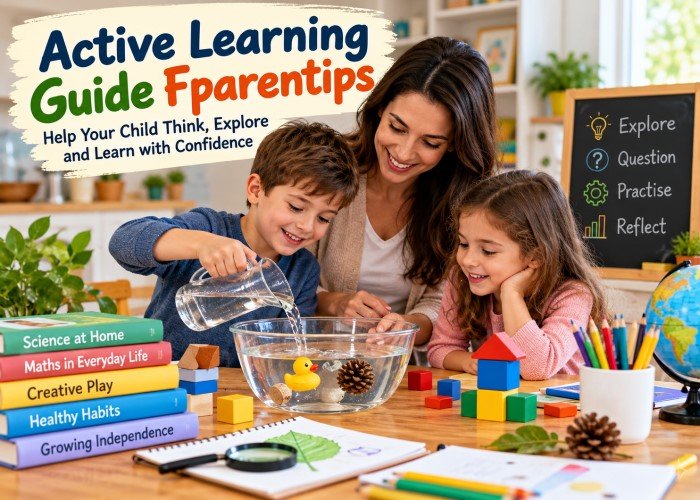
Children do not need expensive equipment or endless worksheets to become confident learners. Some of their strongest learning moments happen while building a tower, measuring flour or asking why leaves change colour. What matters is whether they think, try and discover.
The Active Learning Guide Fparentips encourages parents to turn ordinary family routines into useful learning experiences. Its central message is simple: give children chances to take part rather than watch from the side. A kitchen task teaches maths; a story builds language skills. Here’s how to make learning work at home.
Quick Bio Chart: Active Learning Guide Fparentips
| Detail | At a glance |
|---|---|
| Resource | Fparentips parenting guide |
| Credited author | Selvian Velmyre |
| Main subject | Active learning at home |
| Primary audience | Parents, carers and families |
| Featured age groups | 1–3, 3–5 and 6–9 years |
| Main approach | Explore, question, practise and reflect |
| Useful materials | Books, blocks, paper and household objects |
| Key aims | Curiosity, independence and problem-solving |
What Is Active Learning Guide Fparentips?
Active Learning Guide Fparentips means doing something meaningful with an idea. A child might predict which object will float, test it in water, notice the result and explain what happened. They learn through experience. Fparentips brings this approach into everyday home life. Parents can offer safe materials and respond to questions with patience.
Active Learning Versus Passive Learning
Explanation matters, but children must also apply what they hear. After learning that plants need water, for example, they can help care for a seedling and observe changes over time. Explanation and practice should work together, without constant entertainment.
Why Active Learning Matters for Child Development
When children have a chance to make decisions, test ideas and explain their thinking, they practise skills that support schoolwork and everyday life. This builds communication, creativity and persistence. A child who builds a bridge from blocks must judge its balance. Group games teach listening and cooperation.
Confidence Grows Through Small Successes
Confidence is built through manageable challenges. Completing a puzzle independently can feel more rewarding than being handed the finished answer. Parents can praise a child’s effort and specific choices: “You tried a wider base, and now the tower stands.” Specific feedback shows what helped.
Creating a Learning-Friendly Home
A useful learning space does not need its own room. A tidy corner with paper, washable pencils, picture books and a few building materials is enough. Keep suitable items within reach. Safety comes first. Remove sharp objects, keep small choking hazards away from younger children, and supervise water play, tools and food preparation. Give freedom within clear boundaries.
Follow Your Child’s Curiosity
Pay attention to the questions your child already asks. If they wonder why shadows move, investigate outside together. If they enjoy cars, use toy vehicles to explore distance, speed or counting.
Three Questions That Encourage Thinking
“What do you notice?” invites careful observation. “What might happen next?” encourages prediction. “What could we change?” develops problem-solving. Allow time to answer.
Active Learning Activities for Different Ages
The Active Learning Guide Fparentips highlights activities for toddlers, preschoolers and primary-school children. Adapt tasks to ability and safety needs.
Ages 1–3: Explore Through the Senses
Toddlers learn through movement, touch, sound and repetition. Offer large stacking blocks, fabric squares or sturdy containers for supervised filling and emptying. Name colours, shapes and actions as they play, then let them repeat an activity in their own way. A simple matching game with large, safe objects introduces sorting. Avoid loose beans, beads and other small items that could cause choking.
Ages 3–5: Ask, Imagine and Experiment
Preschool children often enjoy pretend shops, simple gardening and building challenges. Try a sink-or-float activity using safe household objects and a shallow bowl of water under close supervision. Ask for a prediction before testing each item. Storytelling is equally valuable. Invite your child to invent a different ending to a familiar tale. This builds language and imagination.
Ages 6–9: Solve Real Problems
Primary-school children can follow a basic recipe, measure ingredients and compare quantities. They can also plan a short family walk, read a simple map or design a paper bridge that supports a small toy. Encourage them to explain why one attempt worked better than another. This builds reasoning and reflection.
Ages 10 and Above: Make Independent Choices
Older children may enjoy planning a weekly budget, growing vegetables, researching a local environmental issue or creating a short presentation. Let them choose a question, decide how to explore it and share their conclusions. Offer guidance when needed, but leave space for independent decisions.
Turn Everyday Routines into Learning Moments
Home life offers steady opportunities to practise important skills. At the supermarket, ask a child to compare two prices or estimate the total cost of a few items. While cooking, discuss halves, quarters, temperatures and the order of instructions. During laundry, younger children can match socks or sort clothing by colour. Outside, collect fallen leaves, notice patterns in buildings or count birds. Keep tasks short and enjoyable.
Make Reading an Active Conversation
Reading aloud is not simply about finishing the book. Pause occasionally to ask what a character might feel or why they made a choice. Invite your child to predict the next event, describe an illustration or relate the story to something familiar. Enjoy the story first; discuss it afterwards.
The Parent’s Role: Guide Rather Than Take Over
Children benefit from warmth, structure and space to try. Show them how to begin a task, then allow them to attempt the next step. If they become stuck, offer a small clue before giving the complete solution. It also helps to think aloud during your own activities: “This shelf is too narrow, so I need another way to arrange the books.” Adults learn through trial too.
Let Mistakes Become Useful Feedback
A failed experiment is not wasted time. Ask what changed, what stayed the same and what the child wants to try next. Encourage persistence, but notice when frustration has become too strong. A break can help.
Games, Technology and Learning Together
Board games can support taking turns, counting and planning. Construction toys encourage design and spatial thinking. Group projects give children practice in sharing ideas and listening to different opinions. Choose games that offer decisions and discussion, rather than relying only on quick answers. Digital tools can help when children create, solve or explore something. For example, an interactive map may support a geography task, while a simple drawing programme encourages design. Select age-appropriate content, protect privacy and balance screen use with movement, sleep and face-to-face interaction. Free play and rest matter too.
Supporting Different Needs and Abilities
Children vary in language development, confidence, attention and physical abilities. Some need picture instructions; others benefit from a demonstration, extra time or smaller steps. Use a mixture of speaking, showing and hands-on practice instead of assuming each child has one fixed learning style. If a task is overwhelming, change the materials or offer two manageable choices. If it is too easy, add a new challenge. Parents and teachers can plan suitable support together.
How to Notice Progress Without Pressure
Progress is not only a test score. Notice whether your child asks more detailed questions, explains a decision, tries another method or completes a familiar task with less help. Keep a small record of favourite activities and new achievements if it helps. A drawing, photo of a construction project or brief note can show development over time. Avoid comparisons or constant assessment. Ten enjoyable minutes can achieve more than an exhausting hour.
A Simple Weekly Routine That Families Can Keep
Choose one small discovery each day rather than planning a long lesson. On Monday, compare objects by size or weight. On Tuesday, read a story and talk about a character’s choice. On Wednesday, make something from paper or cardboard. On Thursday, explore a plant, insect or weather change outdoors. On Friday, invite your child to show you what they made or learnt. Keep the order flexible. Repeating challenges can help. At the weekend, ask which activity they enjoyed most and what they would change next time. Let their answer shape the following week.
Common Challenges and Practical Solutions
Busy families can attach learning to routines they already share. Cardboard, pencils and books are enough to begin. If interest fades, let the child choose between two activities or return to the task another day. When a child wants an instant answer, offer a clue or demonstrate the first step. If an activity becomes stressful, simplify it.
Final Thoughts
The Active Learning Guide Fparentips offers a useful reminder that learning does not begin and end at school. Children develop understanding while playing, talking, building, reading and taking part in family life. Parents need safe opportunities and patience, not costly equipment. Start with one small change: ask a thoughtful question, let your child test an idea and talk about what happened. Over time, those ordinary moments can help children become more curious, capable and willing to learn independently.
