
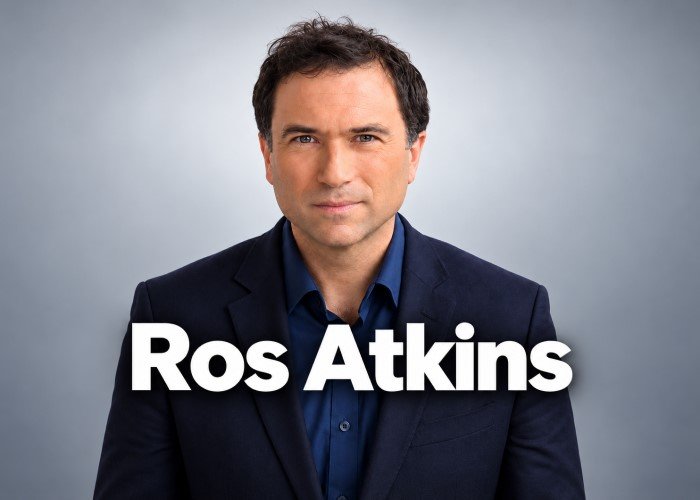
Ros Atkins has built a career on making difficult news easier to understand. As the BBC’s News Analysis Editor, he breaks down major events with calm delivery, research and direct language. Millions have watched his short videos on politics and world affairs. Yet there is another side to his life: he is also a drum-and-bass DJ who has performed at Glastonbury. His journey from a Cornish village to international broadcasting reflects curiosity and a love of music.
Who Is Ros Atkins?
Born in 1974 as Ros Atkins, the journalist is known for BBC programmes including Outside Source, World Have Your Say and The Media Show. He also created the popular Ros Atkins on… video series and wrote The Art of Explanation. His work combines broadcasting, analysis and communication advice. Away from the newsroom, he performs electronic music through his Rave Machine project. His wife is Sara, and they have two daughters.
Early Life, Parents and Education
Childhood in Cornwall and the Caribbean
He grew up in Stithians, a village in Cornwall, but his childhood also took him overseas. His father worked as a mackerel fisherman and later had an opportunity linked to the United Nations Food and Agriculture Organization. The family spent time in Trinidad and Tobago and the Bahamas. These experiences introduced him to different communities and styles of music, especially calypso and soca. His parents’ full names have not been confirmed in trustworthy interviews, and there is no firm detail about his siblings. Although he has spoken openly about parts of his upbringing, he keeps much of his family history private.
School and Cambridge University
He attended Truro School before studying history at Jesus College, Cambridge. As a teenager, he enjoyed theatre, sport and playing keyboards in a jazz-funk band. He took his studies seriously. At Cambridge, he began DJing in 1995 while continuing his academic work.
How Music Became Part of His Life
The Cornish dance scene of the early 1990s sparked his interest in rave culture. Friends shared tapes and stories about parties, and he became fascinated by jungle and drum and bass. The music stayed with him even as journalism became his main profession.
BBC Career: From Radio to International News
His route into journalism was not immediate. After university, he spent time in South Africa and gained early media experience. He also worked on the website of Time Out before joining BBC Radio 5 Live as a producer in 2001. He later moved to the BBC World Service, where he developed his skills as a presenter and interviewer. He became a familiar voice on World Have Your Say, a programme that connected people in different countries through live discussion. The show won a Sony Radio Academy Gold Award for listener participation in 2008. That honour recognised the programme and its wider team.
Building Outside Source
In 2014, he helped launch Outside Source on BBC World News. It brought together live developments, original documents, video clips and correspondents’ accounts. Rather than moving from one prepared report to another, the presenter showed how the parts of a story fitted together. The programme ended in 2023 but influenced his later work.
Why His BBC News Explainers Became So Popular
The Ros Atkins on… videos made him especially well known during the early 2020s. They tackled subjects such as Brexit, Downing Street parties, the war in Ukraine and elections. He built each explanation about a clear question, then used evidence to lead the audience through an answer. His style is measured rather than dramatic. Short sentences, careful editing and strong sources make complex events understandable without losing important facts. One video on the Downing Street Christmas party controversy gained millions of views in 2021. His success showed that serious journalism could travel widely on social media without relying on sensational language. He also helped explain the spread of misinformation online.
The 50:50 Project and Better Representation
A major part of his work took place behind the camera. In January 2017, he began testing a system on Outside Source to improve the balance of women and men appearing as contributors. Journalists counted the guests they could choose and used the figures to guide future decisions. At the start, women made up 39 per cent of contributors on the programme. Within four months, the share had passed 50 per cent. The system grew into the BBC’s 50:50 Project and reached other organisations. It demonstrated how small changes in newsroom habits could make coverage more representative.
Ros Atkins’ Book: The Art of Explanation
His first book, The Art of Explanation: How to Communicate with Clarity and Confidence, was published by Headline in September 2023. It takes the methods used in his broadcasting career and turns them into advice for everyday life. The book sets out ten elements of a strong explanation and seven steps for preparing one. It covers choosing the main point, arranging evidence, removing distractions and speaking with confidence. Its lessons can help with schoolwork, job interviews, meetings and difficult conversations. An audiobook edition is narrated by the author himself.
The central idea is simple: good communication begins with knowing what matters and understanding what another person needs to hear. His book gives practical ways to develop that skill rather than treating it as a natural gift.
Ros Atkins as a DJ: Glastonbury and Rave Machine
Music is far more than a casual hobby for the broadcaster. He first performed as a DJ while at university and later helped organise a Brixton club night called Sharp. He also played at events including Womad. After his eldest daughter was born in 2006, he stepped away from regular DJ performances to spend more time with his family. His return began in 2022 when he recorded a drum-and-bass mix for BBC Radio 6 Music. The response brought fresh invitations and interest. Veteran DJ Ray Keith helped him prepare for bigger performances.
The Glastonbury Moment
In June 2024, he played at Glastonbury Festival’s Stonebridge venue. A highlight was a drum-and-bass version of the famous BBC News theme, developed with producer Crissy Criss and the original composer, David Lowe. The set delighted fans who knew him mainly as a serious television journalist. In 2025, he returned with Ros Atkins’ Rave Machine, bringing other DJs into a shared celebration of dance music. He and Crissy Criss also made The Festival Is Here, a track using the voice of Glastonbury organiser Emily Eavis. His live performances continued in 2026, including events in Cornwall.
Wife, Marriage, Children and Private Life
Ros Atkins’ Wife Sara
He married Sara in 2005. Their engagement has a memorable musical story: he proposed during a Machel Montano concert at London’s Kentish Town Forum in 2004. Sara accepted, and the couple married the following year. They have two daughters. Their eldest was born in 2006, shortly after a DJ performance that became his last regular set for many years. Fatherhood helped change his priorities. In a later interview, he described practising music at home and moving his equipment into the loft to keep the noise down.
Sara’s surname and occupation have not been firmly established through dependable sources. There is also no sound basis for claims about a divorce or a different romantic partner. He shares selected family stories while protecting his children’s privacy.
Radio, Podcasts and Recent Work
Alongside television news, he co-presents The Media Show on BBC Radio 4, examining journalism, broadcasting and the changing media industry. In 2024, he launched Communicating with Ros Atkins, a podcast featuring conversations with skilled communicators such as Martin Lewis, Rob Brydon and Tina Brown. His 2026 Radio 4 series The Value Crisis explored how technology is changing the value people place on work, art, money and relationships. It also questioned the growing influence of artificial intelligence. The series reflects his interest in connecting today’s biggest questions with clear, thoughtful explanation.
Awards, Interests and Financial Details
In November 2025, the Royal Scottish Geographical Society awarded him its Shackleton Medal and an Honorary Fellowship for his contribution to evidence-based journalism. His work has also earned recognition through the success of BBC programmes and his communication projects. Outside work, he enjoys squash, football, cooking and bodyboarding. He has expressed support for Plymouth Argyle and Dulwich Hamlet. His precise birthday remains unconfirmed, so in October 2026 he is 51 or 52. His salary, personal wealth and net worth are not supported by reliable figures, making precise claims misleading.
The Lasting Impact of His Work
What sets him apart is the unusual mix of skills he brings to both broadcasting and music. He can explain a political crisis to a large audience, then fill a festival tent with dance music. His career also shows the value of patient research, clear words and a willingness to pursue different interests. Whether he is presenting news, writing, recording a podcast or playing a DJ set, the aim is similar: to make a genuine connection with people.
