
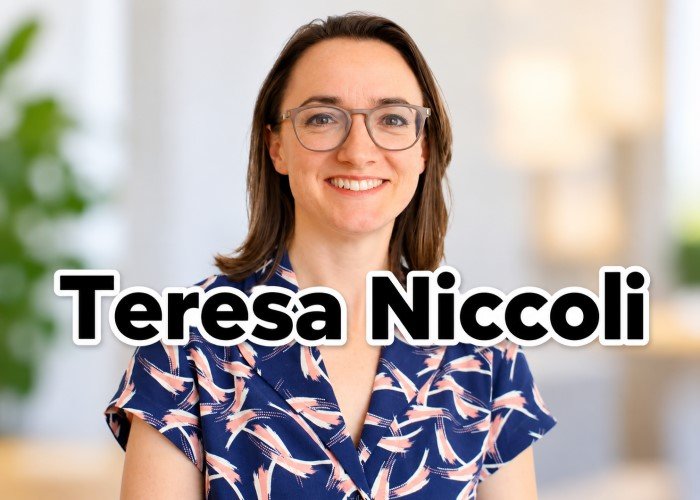
Teresa Niccoli is an Italian molecular biologist and respected dementia researcher based at University College London. Her work focuses on ageing, Alzheimer’s disease, frontotemporal dementia, motor neurone disease and the reasons some brain cells survive while others die. She has built an impressive scientific career while also speaking openly about motherhood, a five-year career break and her return to laboratory research.
She is also known as the wife of Sir Demis Hassabis, the co-founder and chief executive of Google DeepMind and a recipient of the 2024 Nobel Prize in Chemistry. Yet Niccoli has a strong scientific identity of her own. Her studies have contributed to a better understanding of dementia and other conditions that damage the nervous system.
Who Is Teresa Niccoli?
Teresa Niccoli is a molecular and cell biologist whose work centres on neurodegeneration. She is associated with the Institute of Healthy Ageing at University College London, where she leads the Niccoli Lab. Her research team studies what happens inside brain cells during diseases such as Alzheimer’s disease, frontotemporal dementia and amyotrophic lateral sclerosis, also known as ALS. Much of her work uses fruit flies as biological models because many important cellular processes are shared between flies and humans. Her scientific journey has taken her through Cambridge, UCL, King’s College London and major research centres in Britain.
Teresa Niccoli Nationality and Early Life
Teresa Niccoli is Italian. She grew up in northern Italy and attended a scientific secondary school in Brescia before moving to the United Kingdom for higher education. Her Italian schooling gave her a strong foundation in chemistry, physics and biology. These subjects helped prepare her for the demanding Natural Sciences course at the University of Cambridge. Moving from Italy to Britain also meant adapting to a new language and academic system. Despite that challenge, she performed strongly at Cambridge and continued towards a career in scientific research.
Where Did Teresa Niccoli Study?
Niccoli entered Queens’ College, University of Cambridge, in 1994. She studied Natural Sciences and completed her BA in 1997. She later began doctoral research in cell biology and completed her PhD at UCL in 2002. During her doctoral years, she worked in the laboratory of Sir Paul Nurse, one of the world’s leading cell biologists and a Nobel Prize winner. Her early research dealt with cell polarity and microtubule behaviour. She also completed a Master’s degree in Medical Ethics and Law at King’s College London in 2009.
Teresa Niccoli Age
Her exact date of birth has not been confirmed through her university biography or laboratory records. A detailed Italian media feature published in November 2024 described her as 48 years old at that time. Based on that figure, she was born in either 1975 or 1976, depending on the month of her birthday. This distinction matters because another woman with the same name has an online birth date of 26 January 1977. That person is connected with Italian local administration and is not the UCL scientist. For accuracy, Teresa Niccoli’s exact birthday should therefore remain unspecified unless she confirms it herself.
Teresa Niccoli Husband: Demis Hassabis
Teresa Niccoli is married to Sir Demis Hassabis. Hassabis is a British artificial intelligence researcher, entrepreneur and neuroscientist. He co-founded DeepMind, which was later acquired by Google. His work has played a major role in the development of advanced artificial intelligence. In 2024, Hassabis shared part of the Nobel Prize in Chemistry with John Jumper for work connected with AlphaFold2 and protein structure prediction.
Teresa Niccoli and Demis Hassabis at Cambridge
Both Niccoli and Hassabis were connected with Queens’ College, Cambridge, during the 1990s. Niccoli studied Natural Sciences, while Hassabis studied Computer Science. College records confirm their later marriage, although details about exactly when their relationship began have not been established. Their careers developed in very different but connected scientific areas. Hassabis became a major figure in artificial intelligence, while Niccoli built her career in cell biology, ageing and dementia research.
Do Teresa Niccoli and Demis Hassabis Have Children?
Yes. The couple have two sons. Niccoli has spoken openly about taking time away from laboratory science to care for her children. She became pregnant during an early stage of her research career and eventually decided to take an extended break. She spent about five years away from full-time laboratory research while raising her sons. The names, exact ages and other personal details of their children have not been widely shared, and Niccoli and Hassabis have generally kept that part of family life private.
Teresa Niccoli Career Break and Return to Science
One of the most important parts of Teresa Niccoli’s story is her return to science after motherhood. Taking five years away from academic research created challenges. Science moves quickly, and long breaks can make returning difficult. During this period, however, she continued learning. She completed her Master’s in Medical Ethics and Law at King’s College London. In 2010, she returned to laboratory science by joining the group of Professor Dame Linda Partridge at UCL. Her new work concentrated on ageing and neurodegeneration. This marked the beginning of the research direction for which she later became widely recognised.
Teresa Niccoli and Dementia Research
Niccoli studies why certain neurons die during dementia while others remain healthy for longer periods. This question is important because diseases such as Alzheimer’s do not damage every brain cell in the same way. Some cells show greater resistance. Her laboratory studies these differences at molecular level.
Why Teresa Niccoli Uses Fruit Flies
Fruit flies, scientifically called Drosophila melanogaster, are useful in biological research because they have a short lifespan and many genes that work in ways similar to human genes. Scientists can alter specific genes in flies and observe how those changes affect the nervous system. Niccoli uses these models to investigate processes linked with dementia. Promising findings can then be studied further in human cells and other biological systems.
C9orf72, ALS and Frontotemporal Dementia
Niccoli has contributed to major work involving C9orf72, a gene strongly connected with both ALS and frontotemporal dementia. A major study published in 2014 examined how unusual genetic repeat expansions linked with C9orf72 can lead to toxic proteins and damage neurons. This research helped scientists understand an important mechanism behind inherited forms of these serious neurological conditions. Her later work has continued to explore why certain neurons are more vulnerable to this form of toxicity.
Teresa Niccoli Research on Alzheimer’s Disease
Niccoli has also studied how brain cells use energy during Alzheimer’s disease. Research involving her team found that changing glucose transport in neurons could affect amyloid-beta toxicity in experimental models. Her work has also examined PICALM, a gene associated with Alzheimer’s disease. These studies support a wider idea within neuroscience: the way neurons manage energy, proteins and cellular waste may have a major effect on their ability to survive disease.
Research Into Resilient Brain Cells
One of the most interesting areas of Teresa Niccoli’s recent work concerns resilient neurons. Her team has investigated cells that remain alive even when exposed to harmful disease processes. Research published in 2025 examined individual neurons and found that stronger systems for clearing damaged proteins could help certain cells survive. The molecule Xbp1 became an important part of this work. Increasing its activity improved resistance in experimental fly models. This does not mean that Xbp1 is already a treatment for dementia. Human studies are required before such discoveries can become therapies.
Metformin and Neuroprotection
Niccoli has also worked on studies involving metformin, a medicine widely used for type 2 diabetes. Scientists have become interested in whether metformin may affect ageing and brain health. Her research has examined the biological pathways through which metformin could influence neuronal survival and protein control. This work remains part of a developing scientific field and should not be taken as proof that metformin can treat Alzheimer’s disease without further clinical evidence.
Her Personal Connection With Alzheimer’s Disease
Dementia research also has personal meaning for Niccoli. She has spoken about her mother developing Alzheimer’s disease. Experiencing the condition within her own family gave her another perspective on the illness beyond laboratory work. It helped connect the molecular questions she studies with the real impact dementia has on patients and families.
Teresa Niccoli Current Role
Teresa Niccoli works at University College London and leads her own research group within the Institute of Healthy Ageing. She has held an Alzheimer’s Research UK Senior Fellowship and has received support for projects examining dementia, C9orf72 toxicity and neuronal survival. Her work brings together cell biology, genetics, metabolism and neuroscience. She is also involved in scientific communication and activities supporting researchers returning to STEM careers after caring responsibilities.
Teresa Niccoli Net Worth
There is no reliable figure for Teresa Niccoli’s personal net worth. Research grants connected with her work should not be confused with personal wealth. Scientific grants are provided to universities and research groups for staff, laboratory equipment, experiments and related costs. Her husband, Demis Hassabis, has a much higher media presence because of DeepMind, but estimates attached to his finances cannot accurately be presented as Teresa Niccoli’s individual wealth.
Teresa Niccoli’s Importance in Modern Science
Teresa Niccoli’s career combines strong scientific achievement with an unusual personal journey. She moved from Italy to Cambridge, trained with leading scientists, stepped away from laboratory work for five years to raise her children and then successfully rebuilt her research career. Today, her work is helping scientists understand why neurons die, why some survive and how cellular pathways may eventually provide new directions for treating dementia. Her story also shows that a career break does not have to end a scientific career. Through persistence, research and leadership, she has become an important figure in the study of ageing and neurodegenerative disease.
